A painting estimate is an approximate price that can change once a painter sees the job. A quote is a firm price for a defined scope, usually given after a site visit. A bid is a price a painter submits when you are comparing several painters, and in practice most bids are quotes. What matters most is not the word on top, but what the document actually commits to.
Here is how the three differ, how a price moves from one to the next, and what to get in writing before you sign.
The short version
| Estimate | Quote | Bid | |
|---|---|---|---|
| What it is | An approximate price or range | A firm price for a written scope | A price offered in competition with other painters |
| When you get it | Before or without a site visit | After the painter sees the job | After a site visit, alongside other bids |
| Can it change? | Yes, once details are known | Only if the scope changes | Like a quote, until you sign |
| Best used for | Setting a budget | Deciding and signing | Comparing painters side by side |
Painters don’t all use these words the same way. One company’s “estimate” is another company’s “quote.” So read every document for three things: is it a single price or a range, what scope does it cover, and how long is it good for?
What a painting estimate is
An estimate answers the question “about how much will this cost?” It is based on what is known so far: the size of the home or rooms, the type of siding, the number of stories and a general sense of condition.
An online estimate is the most common example. Our free painting estimator gives you a typical price range from your square footage, siding, stories and condition. For a 2,000 square foot two-story with lap siding in good condition, that range is about $6,000 to $10,000 to paint outside, pressure washing included, before sales tax.
An estimate is useful because it gives you a budget before anyone visits. It can’t be final, because some things only show up in person: soft or rotten boards, peeling under the eaves, a steep side yard, or more trim than the photos suggested.
What a painting quote is
A quote is a firm price for a specific scope of work. The painter has seen the home, measured or counted what needs painting, checked the condition and decided on the prep, paint and number of coats. The quote should say all of that in writing.
A good quote is a single number, or one number per line item, not a range. It also says how long the price is good for. Material costs and painters’ schedules change, so a quote usually expires after a set time.
A quote holds as long as the scope stays the same. If you add the fence halfway through, or the painter finds rot behind a gutter, the price changes through a change order: a written note of the extra work and its cost that you approve before the work is done.
What a painting bid is
“Bid” is a word about competition. When you ask several painters to price the same job, each one sends a bid. In residential painting, a bid is usually just a quote that you are comparing with others.
Bids are easiest to compare when every painter prices the exact same scope. If one includes the garage door and two coats and another doesn’t, the lower bid may simply be less work. Our guide on how to read a painting estimate walks through every line and shows how to spot a lowball bid.
A bid is an offer, not a contract. Nothing is binding until you both sign an agreement that spells out the scope, price, payment schedule and start date.
How a price moves from estimate to quote
The range in an estimate narrows to a single price once the painter sees the job. Condition is the most common reason it moves. On the same 2,000 square foot home:
| Condition after a site visit | Typical range |
|---|---|
| Good: sound paint, light wear | $6,000 to $10,000 |
| Fair: some peeling and bare wood | $6,900 to $11,500 |
| Poor: widespread peeling | $7,800 to $13,000 |
If a quote lands far above your estimate, ask the painter which lines changed and why. Good painters will point to specific things: the rot by the back door, the extra story at the rear, the cedar shingles on the gables. If a quote lands far below every other bid, ask what it leaves out.
What to get in writing
Whatever the document is called, before you sign, make sure you have:
- The scope. Every surface or room being painted, and what is not included.
- The prep. Washing, scraping, sanding, caulking, priming and repairs.
- The paint. Product, sheen and number of coats for each surface.
- The price. One total, or one price per line, plus whether sales tax is shown.
- The terms. Deposit, payment schedule, start date, how long the price is good for and how change orders work.
- The warranty. What it covers and for how long.
- The credentials. The company’s Washington L&I contractor registration number.
Use that registration number to confirm the company is registered, bonded and insured. Our guide on how to check a painter’s license, bond and insurance shows you how in about ten minutes. For homes built before 1978, also confirm the company is certified for lead-safe renovation (RRP).
How it works with Online Painting Estimator
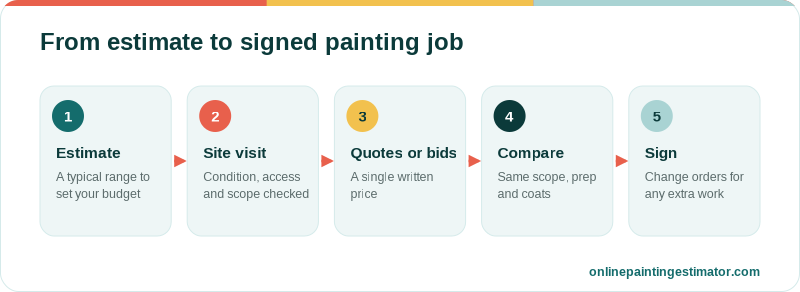
We built our process around this exact path. You start with a free online estimate, so you know the typical range and set your budget. When you send a request, it goes to up to three verified, insured painters matched to your area, type of work and budget. They review the scope and send bids, which our team checks against the estimate range before you see them, so they arrive together and line up side by side.
When you pick one, you sign the agreement and pay a deposit online that is held until the job is finished, and any extra work is added as a change order that you approve. Our guide to how Online Painting Estimator works covers each step.
Common questions homeowners ask
Can a painter charge more than the quote?
Not for the same scope, if you both signed an agreement. Extra work should only be added through a change order you approve.
How long is a painting quote good for?
It varies by painter. The quote should say. If it doesn’t, ask before you rely on it, especially if your start date is months away.
Should I tell painters my budget?
It helps. Painters who know your budget can suggest where to spend and where to save, and painters who can’t work within it can say so early.
Start with an estimate
The fastest way to judge any quote or bid is to know the typical price first. Get your free painting estimate in about two minutes, set your budget, and hear from up to three verified painters whose bids you can compare side by side.
Common questions
Is a painting estimate the same as a quote?
Not quite. An estimate is an approximate price that can change once the painter sees the job. A quote is a firm price for a written scope, usually given after a site visit, that holds as long as the scope doesn't change.
Is a painting bid binding?
A bid is an offer, not a contract. It becomes binding once you both sign an agreement. Until then, either side can change or withdraw it, so check how long the price is good for.
Why did my painting quote come in higher than the estimate?
Usually because the painter found something an estimate couldn't see, such as peeling paint, rot, harder access or extra surfaces. Ask the painter to show which lines changed and why.
Should I pay for a painting estimate?
Many painters give homeowners free estimates and site visits. An online estimate like ours is also free and gives you a typical range before anyone visits.
Know your number before you call a painter
Get a free price range for your project, check it against your budget, then get bids from verified, insured local painters.