A good painting estimate tells you exactly what will be painted, how it will be prepped, what paint goes on, how many coats, and what it costs. If any of those are missing, you cannot compare it fairly with other bids, and a low price may just mean less work. This guide walks through an estimate line by line and shows you how to spot a lowball bid.
Before you read any bid, it helps to know what the job should cost. A quick check with our free painting estimator gives you a typical range for your project to hold each bid up against.
The five parts of a good estimate
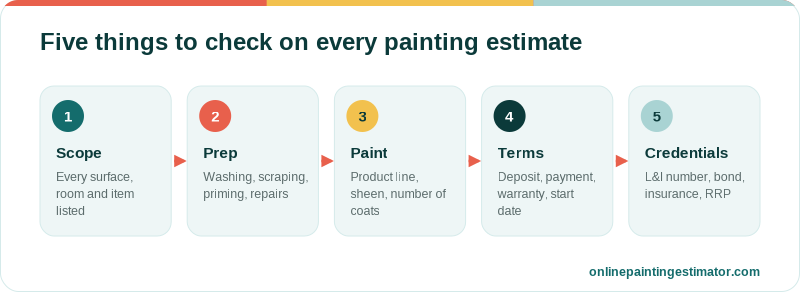
1. Scope: what is being painted
The scope is the list of everything the painter will paint. For an interior, that means each room and whether it includes walls, ceilings, trim, baseboards, doors and closets. For an exterior, it means siding, trim, soffits, fascia, gutters, the front door, the garage door, railings and any outbuildings.
Vague scopes cause most painting disputes. “Paint the exterior” might or might not include the shed, the deck railing or the inside of the garage door trim. If it is not written down, assume it is not included.
2. Prep: what happens before paint goes on
Prep is where good paint jobs are won or lost, especially in Western Washington. Look for specific items:
- Exterior: pressure washing, mildew treatment, scraping loose paint, sanding edges, caulking gaps, spot priming bare wood and replacing or patching rotten boards.
- Interior: moving and covering furniture, filling nail holes, patching dings, sanding, caulking trim and priming stains or repairs.
If one bid lists six prep steps and another just says “prep included,” ask the second painter to spell it out.
3. Paint: product, sheen and coats
An estimate should name the paint brand and product line, or at least the quality level, plus the sheen for each surface. It should say how many coats go on. Two coats is the standard for a lasting finish on most jobs. One coat can be fine for a same-color refresh in good condition, but it should be a choice you make knowingly, not a surprise.
4. Terms: money, timing and warranty
Look for the total price, what the deposit is, when the remaining payments are due, the expected start date and how long the job will take. A written warranty should say what it covers, such as peeling or blistering, and for how long. The estimate should also explain how changes are handled if the painter finds rot or other problems once work begins.
5. Credentials
The estimate or contract should show the company’s Washington L&I contractor registration number. Use it to look up the registration, bond and insurance. Our guide on how to check a painter’s license, bond and insurance shows you how. For homes built before 1978, confirm the company is certified for lead-safe renovation (RRP).
A sample estimate, line by line
Here is what a clear exterior estimate might look like for a 2,000 square foot, two-story home with lap siding in good condition. The prices are typical Puget Sound ranges from our estimator’s rates, before sales tax. A real bid would show one price per line.
| Line item | Typical range |
|---|---|
| Siding and trim, pressure washing included | $6,000 to $10,000 |
| Front door, painted | $450 to $650 |
| Garage door, painted | $850 to $1,100 |
| Total before tax | $7,300 to $11,750 |
Notice what makes this easy to compare: every item is separate, and the doors are not hidden inside one lump sum. If another painter’s bid leaves out the garage door, you can see right away why it is cheaper.
Interior estimates work the same way, room by room. Our interior painting cost per room guide shows typical prices for each size of room so you can check each line.
Sales tax is extra. Washington treats painting for homeowners as a retail sale, so tax applies to the whole job, labor included. Check whether each bid shows tax separately so you compare like with like.
How to spot a lowball bid
A low bid is not automatically a bad one. Some painters are more efficient, have lower overhead or want work in a slow month. But a bid well below both the typical range and the other bids usually has a reason. These are the most common:
- Less prep. No scraping, no priming, or “wash” means a garden hose. The paint looks fine for a season, then peels.
- One coat instead of two. The price drops, and so does the life of the finish.
- A smaller scope. Trim, doors, soffits or ceilings quietly left out.
- Cheaper paint. A contractor-grade product where you expected a premium line.
- No registration or insurance. Companies without a bond, liability insurance or workers’ comp have lower costs, and you carry the risk.
- Change orders later. A low number up front, with “unforeseen” extras added once the job starts.
Questions to ask about a low bid
- What prep is included, step by step?
- How many coats, and which paint product?
- Is everything on the other bids included here?
- What happens, and what does it cost, if you find rot or damage?
- Can I see your L&I registration and certificate of insurance?
If the answers check out, the low bid may be a good deal. If they do not, you have found the gap.
Comparing bids fairly
The easiest way to compare bids is to give every painter the same scope from the start. Write down the rooms or surfaces, the condition, your color plans and any doors or extras, then ask each painter to price exactly that. Our estimator does this for you: your request goes to painters with the scope, condition and budget already filled in, so the bids you get back line up.
When the bids arrive, line them up item by item: scope, prep, paint, coats, warranty and price. The best value is often in the middle, from a registered, insured painter whose estimate is the clearest.
For more context on typical prices, read our guide to what it costs to paint a house in Washington. If you are pricing a kitchen, our cabinet painting cost guide explains how cabinet bids are counted per door and drawer front.
Start with a fair number
The best defense against a lowball bid, or an inflated one, is knowing the typical price before anyone visits. Get your free painting estimate in about two minutes, set your budget, and hear from up to three verified, insured painters who fit your job.
Common questions
What should a painting estimate include?
A good estimate lists every surface and room being painted, the prep work, the paint product and sheen, the number of coats, the price, the payment terms and the warranty. It should also show the painter's Washington L&I registration number.
How do I know if a painting bid is too low?
Compare it with a typical price range for your project and with the other bids on the same scope. A bid far below both usually leaves out prep, coats, trim or doors, or comes from a company without proper registration and insurance.
Is a painting estimate the final price?
Not always. Some estimates are fixed prices for a defined scope, and others are ranges that change once the painter finds hidden problems. The estimate should say which it is and how changes are handled.
How much deposit is normal for a painting job?
A modest deposit to cover materials and hold your start date is common. Be cautious about paying most of the price before work begins, and tie later payments to finished stages of the job.
Know your number before you call a painter
Get a free price range for your project, check it against your budget, then get bids from verified, insured local painters.