The price of a painting lead tells you very little. What matters is what you pay to win a job, and that depends on how many leads it takes to land one. A cheap lead that never closes costs more than an expensive one that does. Here is how to do the math for your own company, and how the three common ways of paying for leads compare.
The three ways lead services charge
| Model | You pay when | Who carries the risk |
|---|---|---|
| Pay per lead | A homeowner’s request is sent to you | You. You pay whether or not you win |
| Pay per contact or response | You reach out, or the homeowner contacts you | Mostly you |
| Pay per job won | The homeowner hires you | Shared. You pay only for work you get |
Large lead marketplaces have mostly used the first two models. They can work, but the cost lands on you before you know whether the job is real, in your area, or in your price range.
The formula
To compare any lead source, work out your cost per job won:
Cost per job won = cost per lead ÷ close rate
If a lead costs $50 and you win 1 in 5 (a 20% close rate), each job you win cost you $250 in leads. If you win 1 in 10, it cost you $500. That’s before your time driving out, measuring and writing up the estimates you didn’t win.
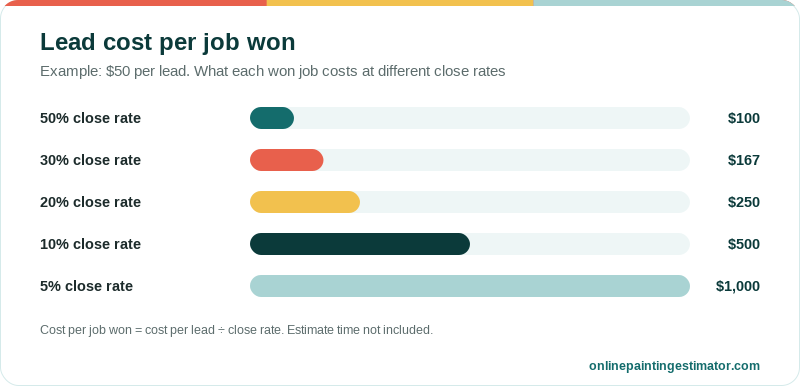
These figures use an example lead price of $50 to show the effect of close rate. Plug in what you actually pay.
Don’t forget the estimate time
Every lead you chase takes time: calls, a site visit, measuring, writing the estimate, following up. Say each one takes two to three hours of an owner’s or estimator’s time. At a 20% close rate, that’s 10 to 15 hours for every job you win, on top of the lead fees.
That’s why leads shared with many companies are so expensive. When eight painters call the same homeowner, most of them will spend that time and lose.
What makes a lead close
From the painter’s side, a few things make a request far more likely to turn into a job:
- It’s shared with few companies. Three bidders gives each a real chance. Eight turns it into a price war.
- The homeowner has a realistic budget. Many lost bids are homeowners who expected half the price.
- The scope is clear before you visit. Size, condition, rooms and timeline up front mean fewer wasted trips.
- The job is in your area and your trade. A cabinet job 40 minutes away isn’t worth it to an exterior-only crew.
Worked example: commission instead of lead fees
On Online Painting Estimator, there is no fee per lead. Painters pay a monthly plan plus a commission only on jobs they win. Every plan gets the same requests:
| Plan | Monthly | Commission on jobs you win |
|---|---|---|
| Basic | $49 | 8% |
| Pro | $129 | 6% |
| Elite | $249 | 5% |
The first 3 months are free after approval, with no card needed to join.
Take an $8,000 exterior repaint, in the typical range for a 2,000 square foot two-story home around here (see our Washington house painting cost guide):
- Basic: 8% of $8,000 = $640 commission, plus $49 for the month
- Pro: 6% of $8,000 = $480 commission, plus $129 for the month
- Elite: 5% of $8,000 = $400 commission, plus $249 for the month
If you don’t win a job that month, you’ve paid only the plan fee. During the first 3 months, you pay nothing at all for the plan.
Compare that with your current cost per job won from the formula above. For many companies with close rates under 25%, paying only on wins comes out ahead. For a company that closes most of what it quotes, per-lead pricing may still be cheaper. Run your own numbers.
Track it by source
You can’t manage what you don’t measure. A simple spreadsheet is enough:
| Source | Leads this month | Estimates given | Jobs won | Close rate | Spent | Cost per job won |
|---|---|---|---|---|---|---|
| Referrals | ||||||
| Google profile | ||||||
| Lead platform A | ||||||
| Online Painting Estimator |
After two or three months, it’s usually obvious which sources earn their cost and which just keep you busy.
Bottom line
The cheapest lead isn’t the one with the lowest price. It’s the one most likely to turn into a job you want, at a price that works for you. Know your close rate, count your estimate time, and pick lead sources where you aren’t one of many companies calling the same homeowner.
If you run a licensed, bonded and insured painting company in King, Snohomish, Pierce or Skagit County, apply to join. More guides for painting companies are in our For painters section.
Common questions
How much should a painting contractor spend to win a job?
A common rule of thumb is to keep the cost of winning a job to a small share of what the job earns, often in the range of 5 to 10 percent of the job price. Work out your own number from your margins, then compare every lead source against it.
Why are my painting leads not converting?
Usually because the lead was shared with many companies, the homeowner had no budget in mind, or the job was out of your area or your price range. Check what you know about a lead before you pay for it.
Is pay per lead or commission better for painters?
It depends on your close rate. If you win most of the jobs you quote, paying per lead can be cheap. If you win one in five or fewer, a model where you only pay when you win usually costs less per job.
What is a good close rate for painting estimates?
It varies widely by company and lead source. Referrals close far more often than leads shared with many companies. Track your own close rate by source for a few months and you'll know which sources are worth paying for.
Know your number before you call a painter
Get a free price range for your project, check it against your budget, then get bids from verified, insured local painters.